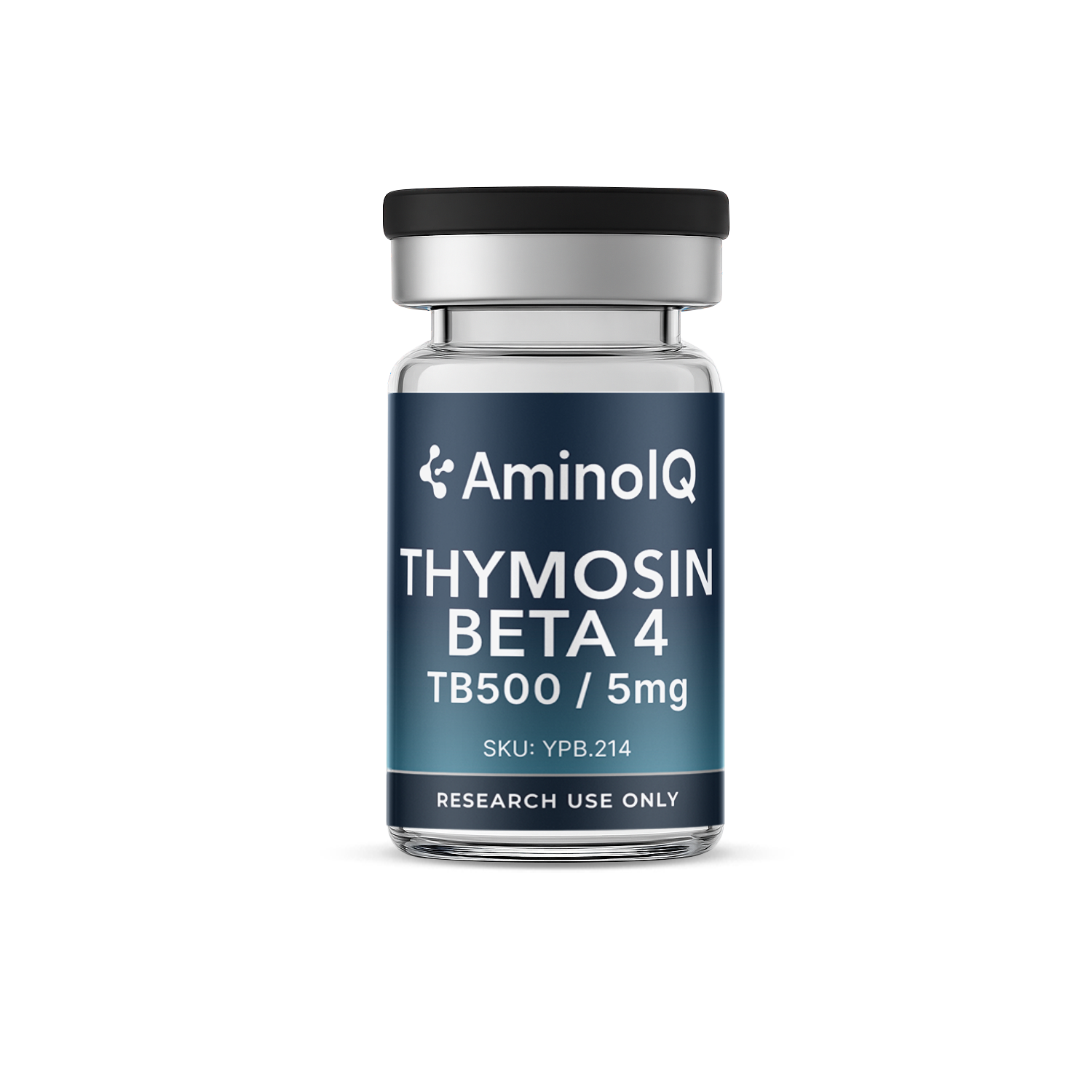
Thymosin Beta 4 (TB500)
Price range: $75.00 through $130.00
Description
A single-component research material supplied for controlled research environments. Suitable for studies involving peptide characterization and method development in model systems.
Composition
• Thymosin Beta 4 (TB-500)
• Appearance: Lyophilized powder in a sealed research vial
Research Focus (non-clinical)
• Peptide identity and purity assessment via HPLC/LC-MS
• Assay development and calibration for quantitative analysis
• Chromatographic method optimization for impurity profiling and peak resolution
• Stability characterization of a lyophilized peptide under laboratory storage conditions
For qualified research professionals and institutional laboratories. Not for human use.
Documentation & Quality Assurance
Each lot is sourced through our verified global supply chain with emphasis on traceability and quality control. We work diligently to obtain and maintain third-party analytical reports (HPLC/LC-MS) and Certificates of Analysis for each batch, as part of our ongoing quality process. These documents are reviewed internally and displayed as they become available. Independent third-party testing is also performed on select lots to confirm identity, purity, and alignment with our internal specifications.
Important Notice
This product is intended for laboratory research use only. It is not intended for human or veterinary use, and must not be used for diagnostic, therapeutic, or clinical purposes.
This material is not a drug, medical device, or dietary supplement, and has not been evaluated by the U.S. Food and Drug Administration.
Quality & Manufacturing
All materials are sourced from carefully vetted domestic and international manufacturing partners who follow quality systems consistent with ISO and cGMP principles. Each supplier is reviewed for reliability, documentation integrity, and transparency in testing.
We require a verified purity of 99% or higher and perform independent third-party spot testing to confirm that select lots meet our internal standards for identity, purity, and composition. Where available, endotoxin testing results are included on Certificates of Analysis to verify laboratory purity; their inclusion is for research quality assessment only and does not imply suitability for human or veterinary use.
All research materials are sealed for integrity and packaged for stability during storage and transport from manufacturing through final delivery.
Additional information
| Weight | 0.05 lbs |
|---|---|
| Dosage | 5mg, 10mg |
Storage Instructions
All our research peptides are manufactured using a lyophilization (freeze-drying) process. This method is designed to maintain product integrity and allows vials to remain stable during shipping for approximately 3–4 months.
Once a vial is reconstituted with bacteriostatic water, it should be stored in the refrigerator to help maintain stability. Under these conditions, reconstituted material is generally considered stable for up to 30 days.
Lyophilization is a dehydration technique in which compounds are frozen and then exposed to low pressure. This causes the water in the vial to sublimate directly from solid to gas, leaving behind a stable, crystalline white structure. This powder can be kept at room temperature until reconstitution.
Upon receipt, products should be stored away from heat and light. For short-term use, refrigeration at approximately 4°C (39°F) is suitable. For long-term storage (several months to years), vials may be placed in a freezer at approximately -80°C (-112°F). Freezing is the preferred method for preserving product stability over extended periods.
⚠️ Important Notice: These products are intended for research use only. Not for human consumption.
Certificate of Analysis
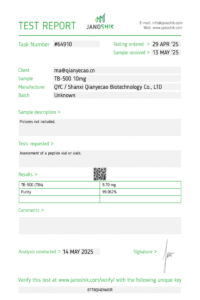
Research Use Only
These studies reference research-grade peptides for laboratory and scientific investigation only. Not for human consumption. Not intended to diagnose, treat, cure, or prevent any disease.
Published Scientific Research
Peer-reviewed laboratory research investigating regenerative peptides from leading scientific databases
Plasmacytoid dendritic cells alleviate allergic asthma via airway epithelial cell-dependent thymosin β4 expression.
METHODS: Blood dendritic cell antigen 2-diphtheria toxin receptor (BDCA2-DTR) mice were used for pDC depletion. RNA sequencing of sorted mouse lung pDCs, in vitro cell experiments, and in vivo CCR2 blockade or thymosin β4 (Tβ4) supplementation were performed to elucidate the underlying mechanism.
View Full StudyThymosin Beta-4 Modulates Cardiac Remodeling by Regulating ROCK1 Expression in Adult Mammals.
It equally reduces scarring, however, the precise mechanisms through which the peptide assists this phenomenon have not been properly elucidated. We performed miRNA profiling on adult mice hearts following permanent coronary ligation with or without systemic TB4 injection and searched for targets and novel mechanisms through which TB4 may mitigate pathological scarring in the heart.
View Full StudyThymosin β and β Expression in Human Organs during Development: A Review.
This review summarizes the results of a series of studies performed by our group with the aim to define the expression levels of thymosin β and thymosin β over time, starting from fetal development to different ages after birth, in different human organs and tissues. The first section describes the proteomics investigations performed on whole saliva from preterm newborns and gingival crevicular fluid, which revealed to us the importance of these acidic peptides and their multiple functions. Th
View Full StudyThymosin β4 promotes zebrafish Mauthner axon regeneration by facilitating actin polymerization through binding to G-actin.
RESULTS: Our results demonstrated that knockout of Tβ4 impaired axon regeneration, whereas overexpression of Tβ4 promoted axon regeneration. The proportion of straight tails was significantly negatively correlated with axon regeneration length, suggesting that it is a new indicator for assessing rapid escape behavior recovery.
View Full StudyThymosin β4 and Actin: Binding Modes, Biological Functions and Clinical Applications.
Based on this, Tβ4 is known to have a wide range of effects, including regulation of inflammation and tumor metastasis, promotion of angiogenesis, wound healing, regeneration of hair follicles, promotion of the development of the nervous system, and improving bone formation and tooth growth.
View Full StudyThymosin beta-4 - A potential tool in healing middle ear lesions in adult mammals.
Acute tympanic membrane perforations primarily occur due to injury or infection in humans. In acute cases, nearly 80-94 % of the perforations heal spontaneously. In chronic cases, non-surgical treatment becomes significantly limited, and the perforation can be restored only by myringoplasty. In addition to classical grafts such as the fascia or cartilage, promising results have been reported with various biological materials including silk or acellular collagen. However, despite of all the effor
View Full StudyRelated products
-

GLP-3 RT
Price range: $130.00 through $380.00Add to cart This product has multiple variants. The options may be chosen on the product page -
-
GHK-Cu
Price range: $70.00 through $130.00Add to cart This product has multiple variants. The options may be chosen on the product page