Glutathione
Price range: $85.00 through $150.00
Description
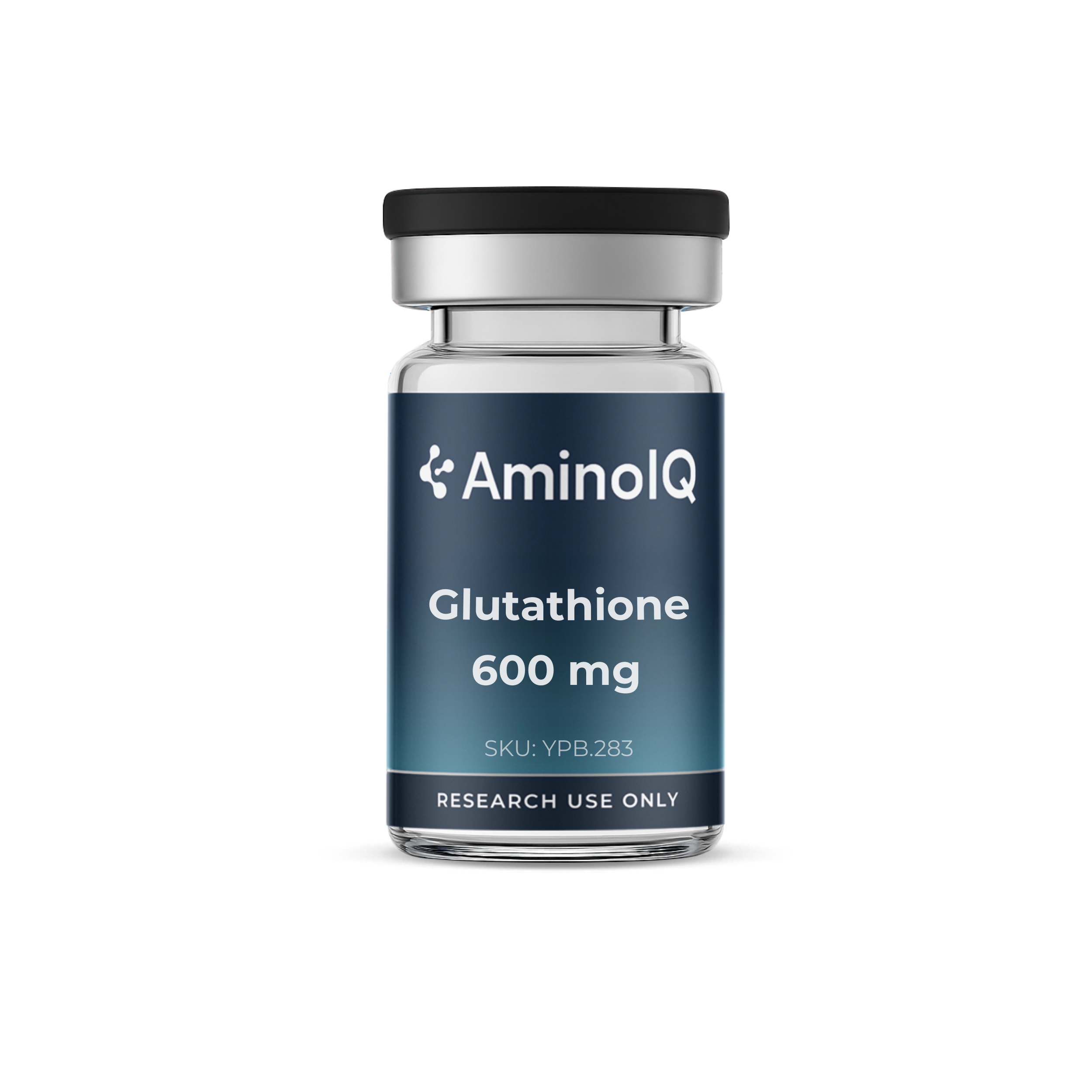
A single-component research material supplied for controlled research environments. Glutathione (600 mg) is a tripeptide (γ-L-glutamyl-L-cysteinylglycine) widely studied for its role in redox regulation, detoxification pathways, and cellular defense mechanisms. This preparation is intended for research use in biochemical and pharmacological model systems.
Composition
• Glutathione
• Appearance: Lyophilized powder in a sealed research vial
Research Focus (non-clinical)
• Quantitative assessment of intracellular redox status and glutathione-dependent enzymes
• Studies on oxidative stress, detoxification, and antioxidant capacity in cell cultures
• Assay development for HPLC/LC-MS-based glutathione measurement
• Stability, solubility, and reconstitution profiling under controlled storage conditions
For qualified research professionals and institutional laboratories. Not for human use.
Documentation & Quality Assurance
Each lot is sourced through our verified global supply chain with emphasis on traceability and quality control. We work diligently to obtain and maintain third-party analytical reports (HPLC/LC-MS) and Certificates of Analysis for each batch, as part of our ongoing quality process. These documents are reviewed internally and displayed as they become available. Independent third-party testing is also performed on select lots to confirm identity, purity, and alignment with our internal specifications.
Important Notice
This product is intended for laboratory research use only. It is not intended for human or veterinary use, and must not be used for diagnostic, therapeutic, or clinical purposes.
This material is not a drug, medical device, or dietary supplement, and has not been evaluated by the U.S. Food and Drug Administration.
Quality & Manufacturing
All materials are sourced from carefully vetted domestic and international manufacturing partners who follow quality systems consistent with ISO and cGMP principles. Each supplier is reviewed for reliability, documentation integrity, and transparency in testing.
We require a verified purity of 99% or higher and perform independent third-party spot testing to confirm that select lots meet our internal standards for identity, purity, and composition. Where available, endotoxin testing results are included on Certificates of Analysis to verify laboratory purity; their inclusion is for research quality assessment only and does not imply suitability for human or veterinary use.
All research materials are sealed for integrity and packaged for stability during storage and transport from manufacturing through final delivery.
Additional information
| Weight | 0.05 lbs |
|---|---|
| Dosage | 1500mg, 600mg |
Storage Instructions
All our research peptides are manufactured using a lyophilization (freeze-drying) process. This method is designed to maintain product integrity and allows vials to remain stable during shipping for approximately 3–4 months.
Once a vial is reconstituted with bacteriostatic water, it should be stored in the refrigerator to help maintain stability. Under these conditions, reconstituted material is generally considered stable for up to 30 days.
Lyophilization is a dehydration technique in which compounds are frozen and then exposed to low pressure. This causes the water in the vial to sublimate directly from solid to gas, leaving behind a stable, crystalline white structure. This powder can be kept at room temperature until reconstitution.
Upon receipt, products should be stored away from heat and light. For short-term use, refrigeration at approximately 4°C (39°F) is suitable. For long-term storage (several months to years), vials may be placed in a freezer at approximately -80°C (-112°F). Freezing is the preferred method for preserving product stability over extended periods.
⚠️ Important Notice: These products are intended for research use only. Not for human consumption.
Certificate of Analysis
COA pending — third-party verification in progress
Research Use Only
These studies reference research-grade peptides for laboratory and scientific investigation only. Not for human consumption. Not intended to diagnose, treat, cure, or prevent any disease.
Published Scientific Research
Peer-reviewed laboratory research investigating research peptides from leading scientific databases
Peptide AEDL and Glutathione Stimulates Root Development .
Glutathione (GSH) plays an important role in the stress resistance and redox homeostasis of plant cells and effectively protects the cell from the stress-induced generation of ROS. A scheme of the mechanism behind the regulation of the redox balance in the stem cell niche and the participation of the AEDL and GSH peptides in the regulation of the fate of stem cells was proposed.
View Full StudyDetection of Protein-Protein Interactions Using Glutathione-S-Transferase (GST) Pull-Down Assay Technique.
Pull-down assay is a technique to analyze direct protein-protein interaction under in vitro condition. Also, this technique is appropriate for investigating the direct interaction between two purified proteins. Glutathione-s-transferase (GST) protein is a widely used affinity tag for affinity purification. In this chapter, we explain the widely used GST pull-down assay to identify the protein-protein interaction between purified proteins.
View Full StudyCritical Roles of the Cysteine-Glutathione Axis in the Production of γ-Glutamyl Peptides in the Nervous System.
γ-Glutamyl moiety that is attached to the cysteine (Cys) residue in glutathione (GSH) protects it from peptidase-mediated degradation. The sulfhydryl group of the Cys residue represents most of the functions of GSH, which include electron donation to peroxidases, protection of reactive sulfhydryl in proteins via glutaredoxin, and glutathione conjugation of xenobiotics, whereas Cys-derived sulfur is also a pivotal component of some redox-responsive molecules. The amount of Cys that is available
View Full StudyEnhancing Photothermal Therapy Efficacy by Self-Assembly in Glioma.
The residence time of some small molecular imaging and therapeutic agents in tumor tissue is short and the molecules can be easily dispersed, which decreases treatment efficacy. Therefore, methods that enhance oncotherapy performance are of significant importance. Here, we report an self-assembly strategy aimed at enhancing the photothermal therapy of glioblastomas. The probe, ICG-PEP-c(RGD)fk, consisted of a glutathione-reactive self-assembling polypeptide as the skeleton, indocyanine green (I
View Full StudyGlutathione S-Transferases Mediate In Vitro and In Vivo Inactivation of Genipin: Implications for an Underlying Detoxification Mechanism.
Genipin (GP), the reactive metabolite of geniposide (GE), is responsible for GE-induced hepatotoxicity. As a potential detoxification pathway, the inactivation of GP by glutathione S-transferases (GSTs) has not yet been characterized.
View Full StudyMolecular Docking Studies and the Effect of Fluorophenylthiourea Derivatives on Glutathione-Dependent Enzymes.
1-(2,6-difluorophenyl)thiourea was showed the best inhibition effect for both GST and GR enzymes.
View Full StudyRelated products
-

-
-
GHRP-6 Acetate
Price range: $40.00 through $70.00Add to cart This product has multiple variants. The options may be chosen on the product page