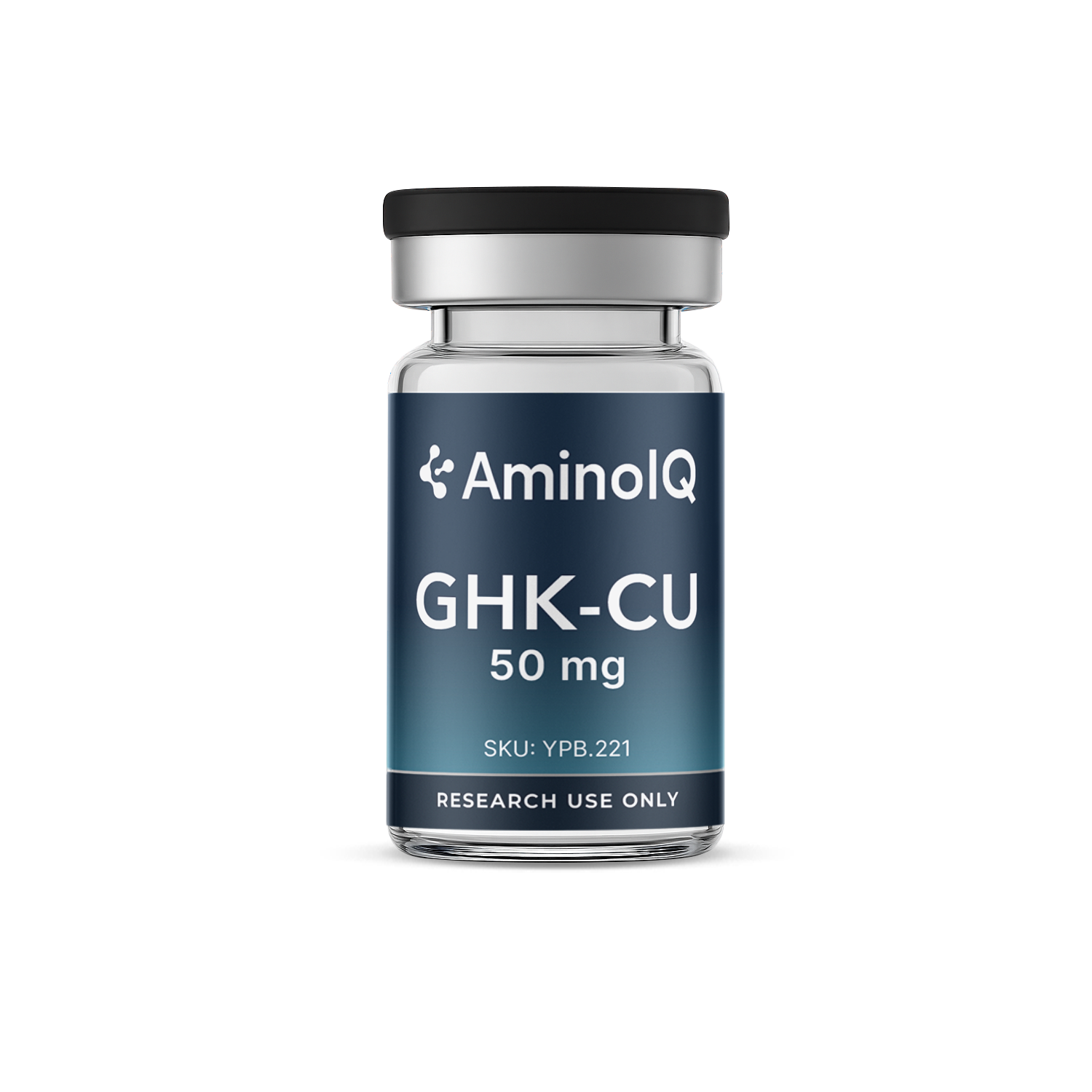
GHK-Cu
Price range: $70.00 through $130.00
Description
A single-component research material supplied for controlled research environments. Suitable for studies involving peptide characterization and method development in model systems.
Composition
• GHK-Cu
• Appearance: Lyophilized powder in a sealed research vial
Research Focus (non-clinical)
• Peptide identity and purity assessment via HPLC/LC-MS
• Assay development and calibration for quantitative analysis
• Chromatographic method optimization for impurity profiling
• Stability characterization of a lyophilized peptide under laboratory storage conditions
For qualified research professionals and institutional laboratories. Not for human use.
Documentation & Quality Assurance
Each lot is sourced through our verified global supply chain with emphasis on traceability and quality control. We work diligently to obtain and maintain third-party analytical reports (HPLC/LC-MS) and Certificates of Analysis for each batch, as part of our ongoing quality process. These documents are reviewed internally and displayed as they become available. Independent third-party testing is also performed on select lots to confirm identity, purity, and alignment with our internal specifications.
Important Notice
This product is intended for laboratory research use only. It is not intended for human or veterinary use, and must not be used for diagnostic, therapeutic, or clinical purposes.
This material is not a drug, medical device, or dietary supplement, and has not been evaluated by the U.S. Food and Drug Administration.
Quality & Manufacturing
All materials are sourced from carefully vetted domestic and international manufacturing partners who follow quality systems consistent with ISO and cGMP principles. Each supplier is reviewed for reliability, documentation integrity, and transparency in testing.
We require a verified purity of 99% or higher and perform independent third-party spot testing to confirm that select lots meet our internal standards for identity, purity, and composition. Where available, endotoxin testing results are included on Certificates of Analysis to verify laboratory purity; their inclusion is for research quality assessment only and does not imply suitability for human or veterinary use.
All research materials are sealed for integrity and packaged for stability during storage and transport from manufacturing through final delivery.
Additional information
| Weight | 0.05 lbs |
|---|---|
| Dosage | 50mg, 100mg |
Storage Instructions
All our research peptides are manufactured using a lyophilization (freeze-drying) process. This method is designed to maintain product integrity and allows vials to remain stable during shipping for approximately 3–4 months.
Once a vial is reconstituted with bacteriostatic water, it should be stored in the refrigerator to help maintain stability. Under these conditions, reconstituted material is generally considered stable for up to 30 days.
Lyophilization is a dehydration technique in which compounds are frozen and then exposed to low pressure. This causes the water in the vial to sublimate directly from solid to gas, leaving behind a stable, crystalline white structure. This powder can be kept at room temperature until reconstitution.
Upon receipt, products should be stored away from heat and light. For short-term use, refrigeration at approximately 4°C (39°F) is suitable. For long-term storage (several months to years), vials may be placed in a freezer at approximately -80°C (-112°F). Freezing is the preferred method for preserving product stability over extended periods.
⚠️ Important Notice: These products are intended for research use only. Not for human consumption.
Certificate of Analysis
COA pending — third-party verification in progress
Research Use Only
These studies reference research-grade peptides for laboratory and scientific investigation only. Not for human consumption. Not intended to diagnose, treat, cure, or prevent any disease.
Published Scientific Research
Peer-reviewed laboratory research investigating research peptides from leading scientific databases
The glycyl-l-histidyl-l-lysine-Cu tripeptide complex attenuates lung inflammation and fibrosis in silicosis by targeting peroxiredoxin 6.
We aimed to investigate the therapeutic effect of GHK-Cu on silicosis and its potential underlying molecular mechanism. These effects were partly related to the inhibition of the CS-induced oxidative stress in AM induced by GHK-Cu.
View Full StudyLiposomes as Carriers of GHK-Cu Tripeptide for Cosmetic Application.
Liposomes are self-assembled spherical systems composed of amphiphilic phospholipids. They can be used as carriers of both hydrophobic and hydrophilic substances, such as the anti-aging and wound-healing copper-binding peptide, GHK-Cu (glycyl-L-histidyl-L-lysine). Anionic (AL) and cationic (CL) hydrogenated lecithin-based liposomes were obtained as GHK-Cu skin delivery systems using the thin-film hydration method combined with freeze-thaw cycles and the extrusion process. The influence of total
View Full StudyUltrasensitive and Label-Free Detection of Copper Ions by GHK-Modified Asymmetric Nanochannels.
This modification facilitated specific recognition and ultra-trace level detection of Cu ions, achieving a detection limit of 10 M. This results in changes of current-potential (-) properties, which facilitated Cu detection.
View Full StudySynergy of GHK-Cu and hyaluronic acid on collagen IV upregulation via fibroblast and ex-vivo skin tests.
INTRODUCTION: GHK-Cu and HA are two commonly used skin care ingredients, both of which were reported to enhance collagen synthesis. This work aims to investigate their co-effect on collagen regulation. MATERIALS AND METHODS: In cell experiments, human dermal fibroblasts were treated by a series of GHK-Cu and HA combinations, and the expressions of collagen I, IV, and VII were measured by qRT-PCR. The best formula screened out from cell experiments were further studied by ex-vivo skin model, and
View Full StudyPolyaspartic acid, 2-acrylamido-2-Methyl propane sulfonic acid and sodium alginate based biocompatible stimuli responsive polymer gel for controlled release of GHK-Cu peptide for wound healing.
Stimuli responsive polymer based on Polyaspartic acid, 2-Acrylamido-2-methylpropane sulfonic acid and sodium alginate (NaAlg) were synthesized using two cross-linkers Ethylene glycol dimethacrylate (EGDMA) and TMPTA (Trimethylolpropane triacrylate). The polymers were standardized and optimized to obtain a polymer with maximum swelling in distilled water, saline, glucose and solutions of varying pH. The synthesized polymer swelled well in distilled water, glucose solution and acidic- alkaline med
View Full StudyEnhanced angiogenic effects of RGD, GHK peptides and copper (II) compositions in synthetic cryogel ECM model.
Synthetic oligopeptides are a promising alternative to natural full-length growth factors and extracellular matrix (ECM) proteins in tissue regeneration and therapeutic angiogenesis applications. In this work, angiogenic properties of dual and triple compositions containing RGD, GHK peptides and copper (II) ions (Cu) were for the first time studied. To reveal specific in vitro effects of these compositions in three-dimensional scaffold, adamantyl group bearing peptides, namely Ada-Ahx-GGRGD (1)
View Full StudyRelated products
-

-
-
5-Amino-1mq
Price range: $50.00 through $140.00Add to cart This product has multiple variants. The options may be chosen on the product page