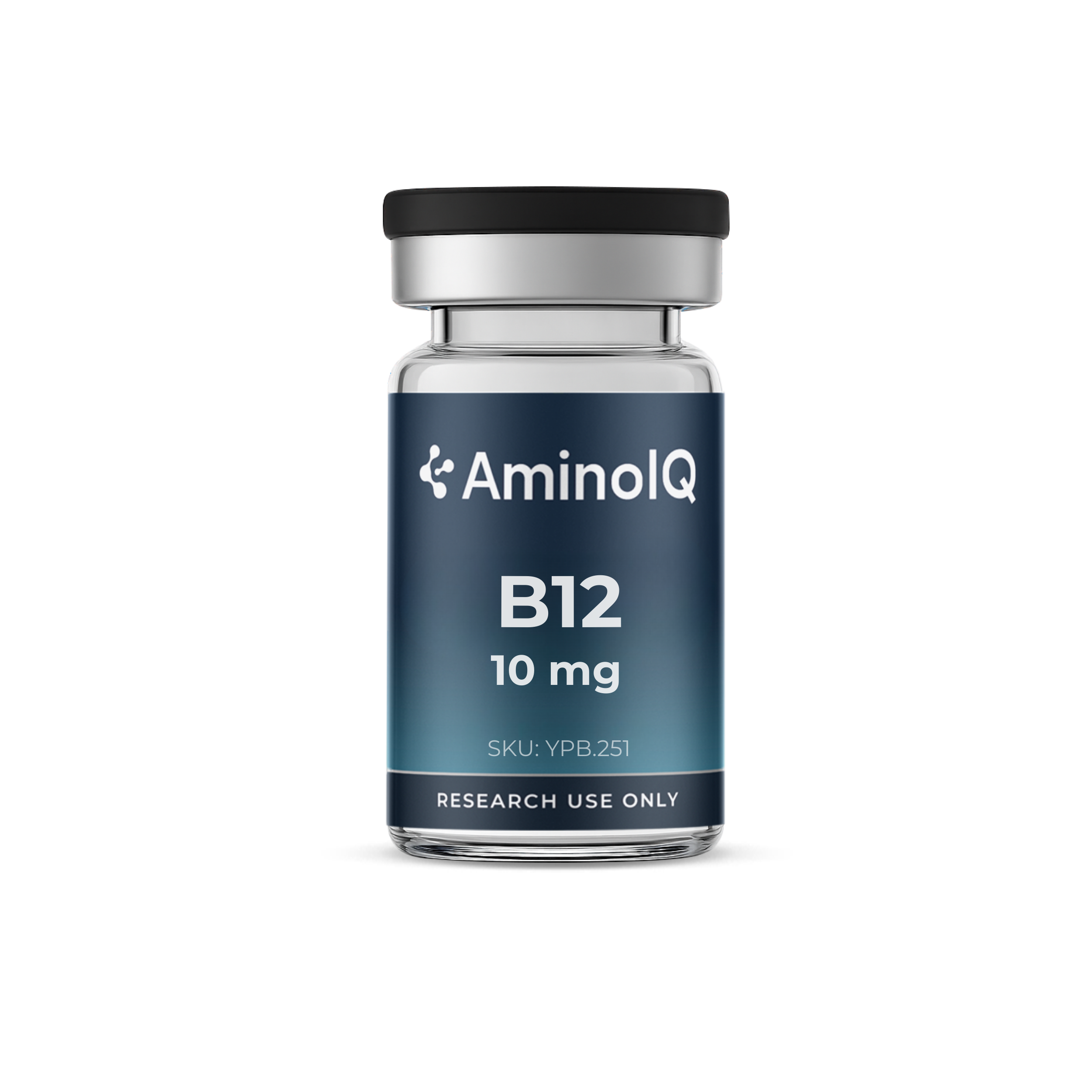
B12 (10ml)
$85.00
Description
A single-component research material supplied for controlled research environments. This 10 mL B12 research solution is designed for laboratory studies exploring cobalamin behavior, stability, and assay development in model systems.
Composition
• B12 Solution
• Appearance: Lyophilized powder in a sealed research vial
Research Focus (non-clinical)
• Analytical method development for cobalamin quantification (HPLC/LC-MS)
• Stability and degradation studies under controlled storage conditions
• Solvent interaction and reactivity profiling in in vitro systems
• Calibration solution for assay standardization
For qualified research professionals and institutional laboratories. Not for human use.
Documentation & Quality Assurance
Each lot is sourced through our verified global supply chain with emphasis on traceability and quality control. We work diligently to obtain and maintain third-party analytical reports (HPLC/LC-MS) and Certificates of Analysis for each batch, as part of our ongoing quality process. These documents are reviewed internally and displayed as they become available. Independent third-party testing is also performed on select lots to confirm identity, purity, and alignment with our internal specifications.
Important Notice
This product is intended for laboratory research use only. It is not intended for human or veterinary use, and must not be used for diagnostic, therapeutic, or clinical purposes.
This material is not a drug, medical device, or dietary supplement, and has not been evaluated by the U.S. Food and Drug Administration.
Quality & Manufacturing
All materials are sourced from carefully vetted domestic and international manufacturing partners who follow quality systems consistent with ISO and cGMP principles. Each supplier is reviewed for reliability, documentation integrity, and transparency in testing.
We require a verified purity of 99% or higher and perform independent third-party spot testing to confirm that select lots meet our internal standards for identity, purity, and composition. Where available, endotoxin testing results are included on Certificates of Analysis to verify laboratory purity; their inclusion is for research quality assessment only and does not imply suitability for human or veterinary use.
All research materials are sealed for integrity and packaged for stability during storage and transport from manufacturing through final delivery.
Additional information
| Weight | 0.05 lbs |
|---|
Storage Instructions
All our research peptides are manufactured using a lyophilization (freeze-drying) process. This method is designed to maintain product integrity and allows vials to remain stable during shipping for approximately 3–4 months.
Once a vial is reconstituted with bacteriostatic water, it should be stored in the refrigerator to help maintain stability. Under these conditions, reconstituted material is generally considered stable for up to 30 days.
Lyophilization is a dehydration technique in which compounds are frozen and then exposed to low pressure. This causes the water in the vial to sublimate directly from solid to gas, leaving behind a stable, crystalline white structure. This powder can be kept at room temperature until reconstitution.
Upon receipt, products should be stored away from heat and light. For short-term use, refrigeration at approximately 4°C (39°F) is suitable. For long-term storage (several months to years), vials may be placed in a freezer at approximately -80°C (-112°F). Freezing is the preferred method for preserving product stability over extended periods.
⚠️ Important Notice: These products are intended for research use only. Not for human consumption.
Certificate of Analysis
COA pending — third-party verification in progress
Research Use Only
These studies reference research-grade peptides for laboratory and scientific investigation only. Not for human consumption. Not intended to diagnose, treat, cure, or prevent any disease.
Published Scientific Research
Peer-reviewed laboratory research investigating research peptides from leading scientific databases
The role of diet and non-pharmacologic supplements in the treatment of chronic neuropathic pain: A systematic review.
Guilongtonluofang, ninjin'yoeito, and antioxidants showed various degrees of potential effectiveness.
View Full StudyCyanocobalamin-Modified Colistin-Hyaluronan Conjugates: Synthesis and Bioactivity.
Vitamin B12 was chosen as a targeting ligand because it has its own absorption pathway in the small intestine. An in vitro release test at pH 7.4 and pH 5.2 showed an ultra-slow release of colistin of approximately 1% after 10 h.
View Full StudyPericonceptional biomarkers for maternal obesity: a systematic review.
The literature was systematically reviewed to identify periconceptional biomarkers of the endocrine, inflammatory and one-carbon metabolic pathways influenced by maternal obesity. Endocrine biomarkers associated with maternal obesity included leptin, insulin, thyroid stimulating hormone, adiponectin, progesterone, free T4 and human chorionic gonadotropin.
View Full StudyMechanistic Insights into the Link between Gut Dysbiosis and Major Depression: An Extensive Review.
Recent advancements in biomedical research have demonstrated a clear correlation between gut dysbiosis (GD) or gut microbial dysbiosis and the development of anxiety or depressive behaviors. The gut microbiome communicates with the brain through the neural, immune, and metabolic pathways, either directly (via vagal nerves) or indirectly (via gut- and microbial-derived metabolites as well as gut hormones and endocrine peptides, including peptide YY, pancreatic polypeptide, neuropeptide Y, cholecystokinin, corticotropin-releasing factor, glucagon-like peptide, oxytocin, and ghrelin).
View Full StudyRole of Dietary Supplements in Thyroid Diseases.
BACKGROUND: Thyroid hormones play a vital role in regulating our body's metabolism. Two important thyroid hormones released from the thyroid gland are tri-iodothyronine (T3) and tetra-iodothyronine (T4). Thyroid-stimulating hormone and thyroid regulating hormone control the T3 and T4 levels in our body. Increased TSH levels indicate hypothyroidism and decreased TSH levels indicate hyperthyroidism. Iodine is a crucial nutrient for the synthesis of thyroid hormones and is mostly obtained from our
View Full StudyEpigenetic Changes and Its Intervention in Age-Related Neurodegenerative Diseases.
Epigenetic mechanisms involving the modulation of gene activity without modifying the DNA bases are reported to have lifelong effects on mature neurons in addition to their impact on synaptic plasticity and cognition. Studies have demonstrated in experimental models of neurodegenerative disorders that manipulations of these two mechanisms influence the susceptibility of neurons to degeneration and apoptosis.
View Full StudyRelated products
-

-
DSIP
Price range: $50.00 through $120.00Add to cart This product has multiple variants. The options may be chosen on the product page -
Epitalon
Price range: $70.00 through $180.00Add to cart This product has multiple variants. The options may be chosen on the product page