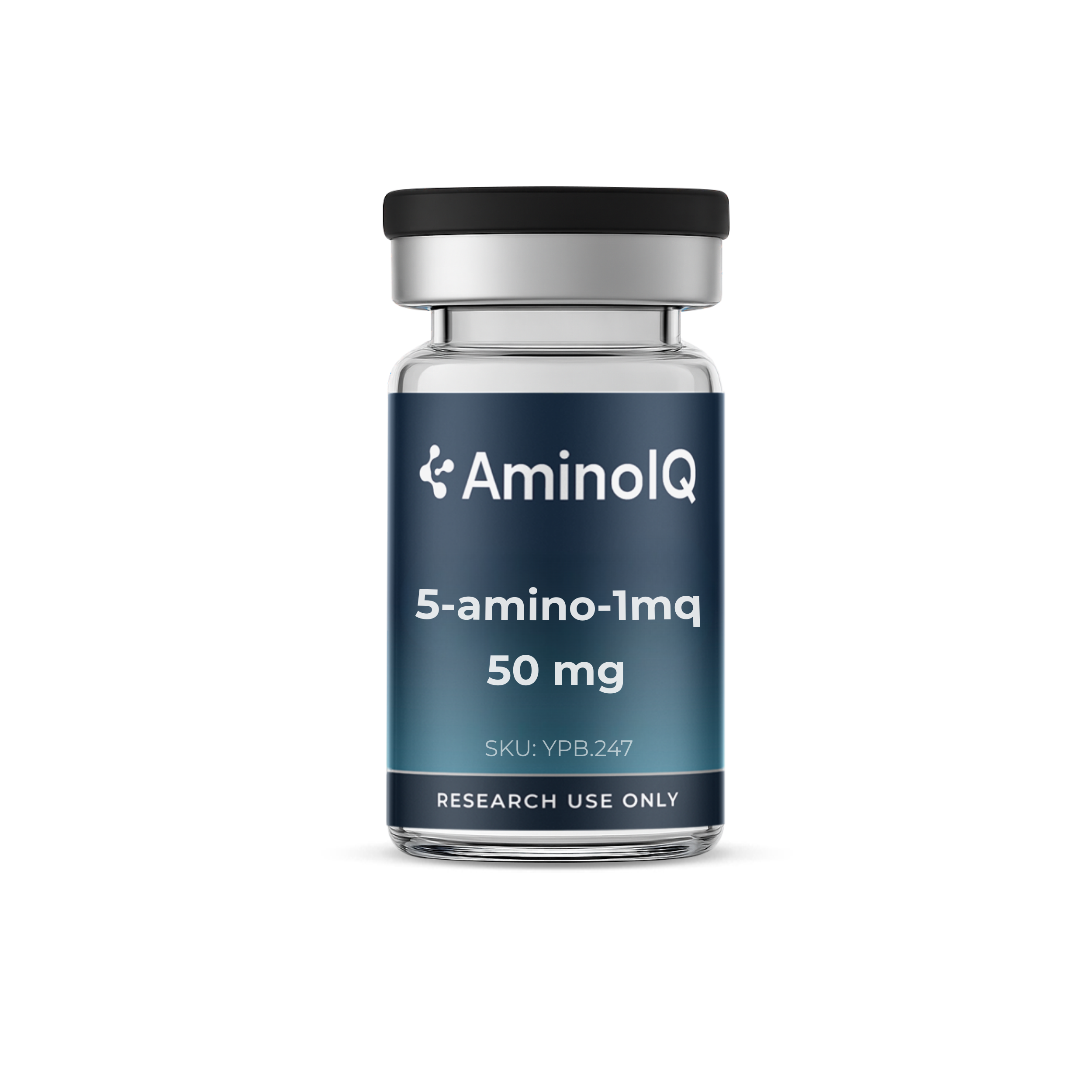
5-Amino-1mq
Price range: $50.00 through $140.00
Additional information
| Weight | 0.05 lbs |
|---|---|
| Dosage | 5mg, 50mg |
Research Use Only
These studies reference research-grade peptides for laboratory and scientific investigation only. Not for human consumption. Not intended to diagnose, treat, cure, or prevent any disease.
Published Scientific Research
Peer-reviewed laboratory research investigating research peptides from leading scientific databases
Recent advances in peptide macrocyclization strategies.
Recently, owing to their special spatial structures, peptide-based macrocycles have shown tremendous promise and aroused great interest in multidisciplinary research ranging from potent antibiotics against resistant strains to functional biomaterials with novel properties. Besides traditional monocyclic peptides, many fascinating polycyclic and remarkable higher-order cyclic, spherical and cylindric peptidic systems have come into the limelight owing to breakthroughs in various chemical (, nativ
View Full StudyNanoassemblies designed for efficient nuclear targeting.
One of the key aspects of coping efficiently with complex pathological conditions is delivering the desired therapeutic compounds with precision in both space and time. Therefore, the focus on nuclear-targeted delivery systems has emerged as a promising strategy with high potential, particularly in gene therapy and cancer treatment. Here, we explore the design of supramolecular nanoassemblies as vehicles to deliver specific compounds to the nucleus, with the special focus on polymer and peptide-
View Full StudyA microfluidic in vitro method predicting the fate of peptide drugs after subcutaneous administration.
A mechanism relating the magnitude of k to the peptides' charge is proposed.
View Full StudyTat-NTS peptide protects neurons against cerebral ischemia-reperfusion injury via ANXA1 SUMOylation in microglia.
Many studies have emphasized a well-established function of Annexin-A1 (ANXA1) in the immune system, including the regulation of microglial activation. We discovered the underlying mechanism that Tat-NTS peptide targets microglial ANXA1 to protect against ischemic brain injury.
View Full StudyPeptide-based covalent inhibitors of protein-protein interactions.
Protein-protein interactions (PPI) are involved in all cellular processes and many represent attractive therapeutic targets. However, the frequently rather flat and large interaction areas render the identification of small molecular PPI inhibitors very challenging. As an alternative, peptide interaction motifs derived from a PPI interface can serve as starting points for the development of inhibitors. However, certain proteins remain challenging targets when applying inhibitors with a competiti
View Full StudyPeptide-based coacervates as biomimetic protocells.
Coacervates are condensed liquid-like droplets formed by liquid-liquid phase separation of molecules through multiple weak associative interactions. In recent years it has emerged that not only long polymers, but also short peptides are capable of forming simple and complex coacervates. The coacervate droplets they form act as compartments that sequester and concentrate a wide range of solutes, and their spontaneous formation make coacervates attractive protocell models. The main advantage of pe
View Full StudyRelated products
-

Glutathione
Price range: $85.00 through $150.00Add to cart This product has multiple variants. The options may be chosen on the product page -
-
GHRP-6 Acetate
Price range: $40.00 through $70.00Add to cart This product has multiple variants. The options may be chosen on the product page