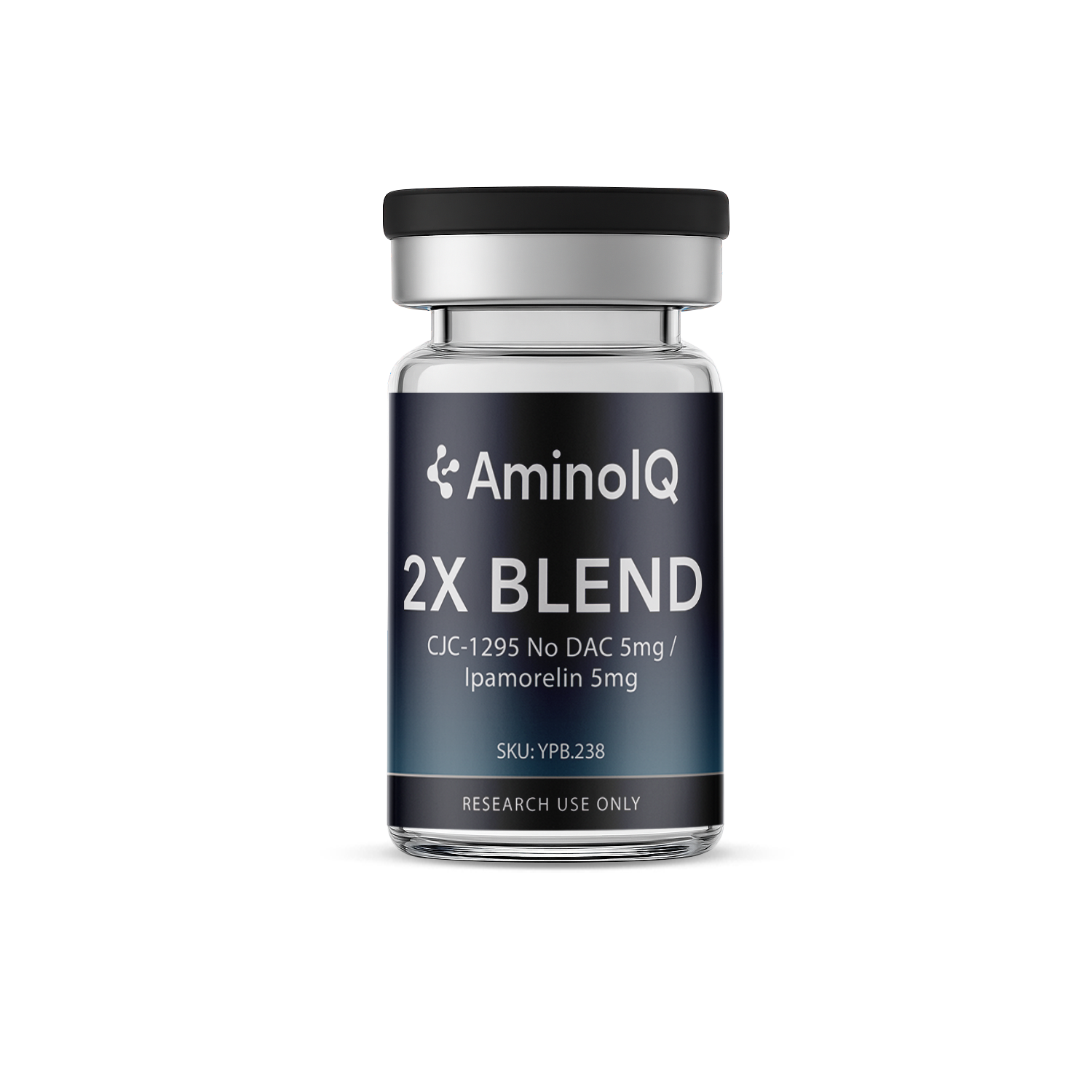
2X Blend CJC-1295 Without DAC (5mg) / Ipamorelin (5mg)
$90.00
Out of stock
Additional information
| Weight | 0.0625 lbs |
|---|---|
| Dosage | 5mg |
Storage Instructions
All products from Amino Supply are manufactured using a lyophilization (freeze-drying) process. This method is designed to maintain product integrity and allows vials to remain stable during shipping for approximately 3–4 months.
Once a vial is reconstituted with bacteriostatic water, it should be stored in the refrigerator to help maintain stability. Under these conditions, reconstituted material is generally considered stable for up to 30 days.
Lyophilization is a dehydration technique in which compounds are frozen and then exposed to low pressure. This causes the water in the vial to sublimate directly from solid to gas, leaving behind a stable, crystalline white structure. This powder can be kept at room temperature until reconstitution.
Upon receipt, products should be stored away from heat and light. For short-term use, refrigeration at approximately 4°C (39°F) is suitable. For long-term storage (several months to years), vials may be placed in a freezer at approximately -80°C (-112°F). Freezing is the preferred method for preserving product stability over extended periods.
⚠️ Important Notice:
These products are intended for research use only. Not for human consumption.
Research Use Only
These studies reference research-grade peptides for laboratory and scientific investigation only. Not for human consumption. Not intended to diagnose, treat, cure, or prevent any disease.
Published Scientific Research
Peer-reviewed laboratory research investigating growth hormone peptides from leading scientific databases
Ghrelin gene products and the regulation of food intake and gut motility.
A breakthrough using "reverse pharmacology" identified and characterized acyl ghrelin from the stomach as the endogenous cognate ligand for the growth hormone (GH) secretagogue receptor (GHS-R) 1a. To date, ghrelin is the only protein to be octanylated, and inhibition of GOAT may have effects only on the stomach and is unlikely to affect the synthesis of other proteins.
View Full StudyGhrelin: from a GH-secretagogue to the regulation of food intake, sleep and anxiety.
Grhelin is an endogenous ligand for the growth hormone secretagogue receptor from the stomach. Ghrelin has other significant actions, including control of acid secretion, influences on sleep and on the regulation of anxiety.
View Full StudyThe role of ghrelin and growth hormone secretagogues receptor on rat adipogenesis.
Recent research progress indicates a close link between ghrelin, a natural ligand of GH secretagogues receptor (GHS-R), and both the metabolic balance and body composition. To clarify the involvement of ghrelin and GHS-R in the process of adipogenesis, we measured the expression of GHS-R and peroxisome proliferator-activated receptor gamma 2 (PPAR-gamma 2) mRNA in rat adipocytes using semiquantitative RT-PCR methods.
View Full StudyGhrelin -- a new endogenous growth hormone secretagogue.
Ghrelin is a new endogenous peptide, discovered in 1999 by Kojima et al., as the result of a search for an endogenous ligand for an orphan receptor of known structure and function. Its discovery is related to the development of a new hypothesis regarding the regulation of growth hormone secretion.
View Full StudyBiologic activities of growth hormone secretagogues in humans.
GHSs release GH via actions on specific receptors (GHS-R) at the pituitary and, mainly, at the hypothalamic levels. Estrogens play a major role in enhancing the GH response to GHSs at puberty, which GHRH hypoactivity, somatostatinergic hyperactivity and impaired activity of the putative GHS-like ligand and receptors probably explain the reduced GH-releasing effect of GHSs in aging.
View Full StudyPhysiology and possible pathology of growth hormone secretagogues.
Recently an endogenous ligand for the GHS receptor, ghrelin, was discovered, suggesting that this may be the third factor in the control of GH secretion. Moreover, the presence of ghrelin in rat and human placenta has been reported, suggesting a possible role of this peptide in the local modulation of GH release and in maternal and fetal pituitary secretion.
View Full Study